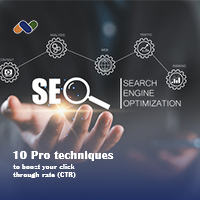
Marketers frequently concentrate all of their SEO efforts on being found.
Getting on the first page of search engine results pages (SERPs) won’t help your business if people aren’t interested in the content you’re offering. They want to strike a careful balance between keyword optimization and “keyword stuffing.”
If you want to rank well for local SEO, don’t put all your efforts into creating content that attracts searchers. Instead, improve your organic click-through rate first (CTR).
Why Should You Be Concerned With Your Organic Click-Through-Rate?
To measure organic click-through rate, search engines track how many people actually click on the results they display. As a result, you’d get your own URL. While ranking position is a major factor (the more people who see your content, the more likely they are to click), it can also have an impact.
You can improve your Google ranking by concentrating your efforts on increasing organic click-through rates (CTR). A search engine’s algorithm will value and consider your page relevant for future queries containing your content keywords if URLs are frequently visited.
A Guide to Increasing Your Organic Click-Through Rate
Knowing what organic CTR is and why it’s important has prepared you for the next step, which is figuring out how to make it better.
Use Keywords with Long Tails
Using long-tail keywords, especially in your headings and title tags, is a great way to increase your organic CTR. As a result, long-tail keywords better match your content with search intent.
They’re more likely to click on your URL if your post contains a descriptive long-tail keyword that matches what they’re looking for in the search results.
What’s the best way to find long-tail keywords that are relevant to what a user is looking for?
Keyword research can be aided by using free tools such as Google Keyword Planner or Ubersuggest. Using the search bar, type in your seed keyword and click “search.” Once you’ve done that, go to the “Keyword Ideas” section in the left-hand menu.
Effective Meta Descriptions: How to Write Them
Writing effective meta descriptions is another way to increase your organic CTR strategically. Below your title tag in the SERPs are snippets of text called H1 and H2. In addition to informing visitors what your page is about, a compelling meta description encourages them to continue reading your post.
Once again, your keyword research will be extremely beneficial in this situation. Use them to demonstrate to readers that your article provides solutions to a problem they’re experiencing. Meta descriptions can be optimised in a variety of ways, including:
Providing answers to users’ questions in the meta description gives you an advantage in increasing your organic click-through rate organically.
Concentrate on what you’re trying to convey. A meta description can only be 160 characters long. As a result, you must tailor yours to be as specific and pertinent as possible.
Provocative language: In order to increase your CTR, use persuasive and powerful language, such as emotionally charged words.
Use meta descriptions as an elevator pitch to persuade users that you have the right content and solution for them rather than just a product feature. Include a CTA (such as “learn more” or “find out how”) if at all possible.
Structured Data Implementation
This is a great way to communicate with search engine algorithms because structured data can be implemented. Using Schema.org to convert your content into code that search engines can understand is one way to accomplish this goal. This will assist them in providing users with more useful, engaging search results. Rich snippets are what they’re called, and we’ll go into more detail about them later.
This type of search result, of course, attracts more clicks for the following reasons:
Search engine results pages (SERPs) show them at the top.
Compared to plain URLs, these are more visually appealing.
On a single glance, they provide more details about the content.
Because people enjoy interactive content, implementing structured data will increase your organic CTR rates.
Use URLs That Describe What You’re Getting At
One of the most important pieces of information displayed on SERPs is the URL of your page. As a result, it needs to be optimised in order to boost your organic click-through rate.
Making it as descriptive as possible is one way to accomplish this.
Include your keyword as naturally as possible in your URL. Thus, your post’s core topic will be further reinforced, demonstrating to readers that your content is both interesting and useful.
Keeping your URL short is an additional SEO tip. As a result, it’s more pleasing to the eye and therefore more appealing. In turn, this increases the number of people who click on it.
It is possible to alter your URL in the permalink settings of your WordPress site.
Simplify the format of your title
You must take your time to format your title tag, which is another part of the information displayed on the SERPs. Keeping it simple is the best strategy for accomplishing this.
Keep in mind that most searchers only read the first few pages of results before moving on to the next one. The more clicks you get because of a simple and descriptive title.
Another title tag optimization tip is to make use of your personal or company branding. As an example, here’s how I go about it:
If you’re already regarded as an expert in your field, this strategy will be especially effective for you. Users will be more likely to click on your URL if they recognise that it comes from a well-known and reliable source. Ensure that:
When I used to put my name at the beginning of the title, my rankings began to suffer as a result.
Make certain that your title is distinct and easy to understand: The screenshot above has been cropped to remove the title, but the subject matter has already been discussed.
Use tools like Avid Demand to see how your content will appear on search engine results pages (SERPs).
Mobile has quickly overtaken desktop as a source of internet traffic. For map purposes, most mobile devices have their locations turned on, which allows Google to read their location and provide them with local solutions to their problems. In-person service businesses and small to medium-sized enterprises (SMEs) benefit greatly from creating localised content.
Localized content allows you to more effectively target your audience and, as a result, attract customers with high intent who are already searching online for what you sell or provide.
Adding your location to your content, meta description, and title tag is one way to localise it. Another recommendation is to make a Google My Business listing for your company (GMB). This puts you on the map, figuratively speaking. When people conduct local searches, your company’s name, address, and other details will appear in the search results alongside those of your rivals.
Keep in mind that relevant information is what will get people to click on your ad. It doesn’t get more relevant for local searches than having your location displayed in your metadata.
Use the Listicle Format Lists are extremely popular with readers.
Why? Listicles are easy to consume because they demand little mental effort on the reader’s part.
Improve your organic clicks by including them in your content strategy. Include numbers in your headline and title tag to accomplish this. As a result, users will know that what awaits them after clicking on the link is a simple listicle.
By increasing your chances of being included in featured snippets, listicles also help boost organic click-through rates (CTR).
Even though the headline doesn’t include a number, Google still shows users in the featured snippet that the post is a listicle. Listicles will boost your organic click-through rate because Google’s SERP knows what types of content are most useful to its users.
A/B Testing of Social Media Headlines
If you want people to click on your article, you need an attention-grabbing headline. Because of its significance, you must ensure that it is well received by your intended audience.
You can do this by putting it to the test on social media platforms like Facebook and Twitter.
It’s time to put your headline to the test. Use tools like CoSchedule’s Headline Analyzer to optimise it. Then, share your article on social media to see how it does.
Change your headline and re-publish your post after a few days. Share the new article on social media and wait the same number of days as you gave the first post before checking the engagement rates for both.
When it comes to choosing a headline, the one that generates the most interest is the one you should use. If you want this A/B test to be successful, you’ll need a sizable social media following.
Use Yoast Preview instead of the default one (in WordPress)
Yoast is another SEO plugin available for WordPress users to help boost their organic click-through rates. You should preview your snippet on search engine results pages (SERPs) before publishing your post. Changes can then be made in accordance with the advice given.
If any keywords are missing or your snippet is illogical, this tool will assist you. So you don’t have to be concerned about cross-platform searches anymore.
Organic CTR (Click-Through-Rate)
The success of your digital marketing campaigns is directly related to the organic click-through rate (CTR).
Your business, brand, products, and services are being viewed by “free” customers.
As a result, improving the quality of your content should be a top priority.